From the Apothecary: Nettle
Share
Urtica dioica — yes, those nettles. The ones you've been avoiding since childhood. The ones that grow in every hedgerow, ditch, and neglected corner of the British countryside. It turns out the most common weed in the UK is also one of the most useful plants in the apothecary. And no — once it's dried, powdered, or cooked, it won't sting.
What It Is
Stinging nettle is a hardy perennial native to the UK and found across the entire country. It spreads by rhizome and self-seeds freely — which is why it's everywhere. The sting comes from tiny hollow hairs on the leaves and stems that inject formic acid on contact. Heat, drying, and grinding all neutralise it completely.
It's been used in British folk herbalism for centuries — as food, as medicine, and as a fibre plant. The Romans are said to have brought it to Britain deliberately. Whether or not that's true, it's been here long enough to be entirely ours.
Nettle for Hair
This is where nettle earns its place in the modern apothecary. Nettle is one of the most traditionally used herbs for hair and scalp care in European herbalism — and "nettle hair rinse" is one of the most searched natural hair remedies in the UK.
A nettle hair rinse is simple to make, costs almost nothing if you forage your own, and leaves hair feeling clean and the scalp refreshed.
Simple Nettle Hair Rinse
You'll need:
- A large handful of fresh young nettle leaves (wear gloves to pick) — or 2 tbsp dried nettle
- 500ml boiling water
Pour boiling water over the nettles and leave to steep for 20–30 minutes until cool. Strain through muslin — the liquid will be a deep green. Pour through clean hair after shampooing. Leave in, no need to rinse out. Use 2–3 times a week.
Forage tip: pick young nettle tops in spring and early summer — the top 4–6 leaves of each plant. Avoid nettles growing near roadsides or agricultural land. Wear gloves until the nettles are in the water.
Nettle for Skin
Nettle is rich in minerals and has been used traditionally for skin that needs nourishing and conditioning. A nettle infusion makes a simple toner — the same method as the hair rinse, applied to clean skin with a cotton pad.
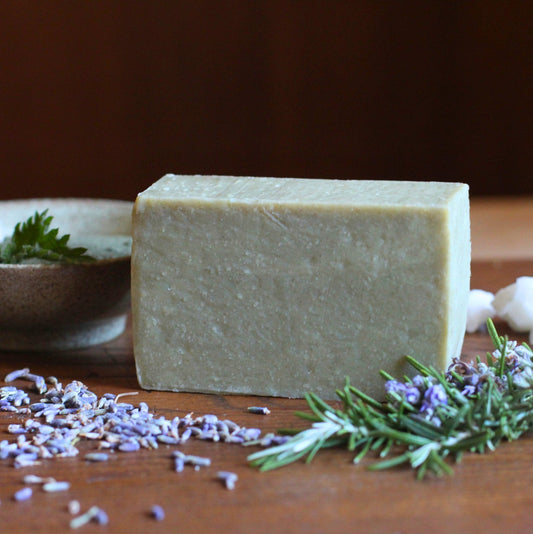
Nettle powder — dried nettles ground to a fine powder — is one of the ingredients in our Original Herb Soap, alongside rosemary and peppermint. It gives the soap its distinctive deep green colour and adds a gentle, mineral-rich quality to the lather. If you've ever wondered what's in it and why — that's the nettle.
Why We Use Nettle Powder in Soap
Incorporating nettle into a cold or hot process soap isn't straightforward — fresh nettles contain too much moisture, and the alkaline environment of soap-making changes how botanicals behave. We use finely ground dried nettle powder, added towards the end of the process, which distributes evenly through the bar and gives a consistent colour and texture batch to batch.
It's one of those ingredients that looks unusual on a label and makes complete sense once you understand it.
Foraging Nettles in the UK
Nettles are one of the safest and most accessible wild plants to forage in Britain. Pick young tops in spring — they're at their most tender and mineral-rich before the plant flowers. Once nettles flower (usually from June), the leaves become coarser and less useful for food or hair care, though they're still fine for skin preparations.
To dry: spread on a rack in a warm, airy spot away from direct light. They'll dry in 2–3 days and can be stored in an airtight jar for up to a year. To powder: blitz dried nettles in a spice grinder or high-powered blender. The powder keeps its colour well and can be used in soap, added to face masks, or stirred into smoothies.
In the Kitchen
Young nettle tops can be cooked exactly like spinach — blanch briefly in boiling water (this neutralises the sting immediately), then drain and use in soups, pasta, risotto, or on toast with butter and a poached egg. Nettle soup is a British spring tradition and genuinely delicious. The flavour is earthy, mineral, and green — more interesting than spinach.
In the Garden
If you have nettles, don't eradicate them entirely. They're the sole food plant for several of Britain's most beautiful butterflies — red admiral, peacock, small tortoiseshell, and comma all lay their eggs on nettle. Leave a patch in a corner and you'll have butterflies all summer.
Nettle liquid feed — nettles steeped in water for a few weeks — makes a free, high-nitrogen fertiliser for hungry plants. It smells terrible. It works brilliantly.
The nettle is proof that the most useful things are often the ones we overlook. It's been growing in British hedgerows for thousands of years, doing exactly what it does — feeding butterflies, feeding people, and quietly being one of the most mineral-rich plants on the island. The apothecary has always known this. Now you do too.