Can Soap Support a Healthy Skin Microbiome?
Share
You've probably heard a lot about the gut microbiome. The skin microbiome gets rather less attention — but it's just as important, and most conventional soaps are quietly making a mess of it every time you shower or bathe.
Time for the geeky bit.....
Here's what's actually going on.
What is the skin microbiome?
Your skin is home to billions of microorganisms — bacteria, fungi, and other microbes — that live on its surface and in its upper layers. This isn't a hygiene problem. It's entirely normal, and in fact essential. These microorganisms form a protective ecosystem that helps regulate inflammation, defend against harmful pathogens, support the skin barrier, and keep skin balanced and resilient.
When the microbiome is healthy, skin tends to be calm, clear, and comfortable. When it's disrupted — by harsh products, over-washing, or the wrong ingredients — you often see the results: dryness, sensitivity, redness, or skin that never quite feels right no matter what you put on it.
How conventional soap disrupts it
Most commercial soap bars are formulated at a high pH — typically around 9 to 10. Healthy skin sits at a pH of around 4.5 to 5.5, which is mildly acidic. This acid mantle is part of what keeps the microbiome stable and the skin barrier intact.
Wash with a high-pH soap regularly and you're repeatedly pushing your skin's pH in the wrong direction. The microbiome struggles to recover between washes, the skin barrier becomes compromised, and the cycle of dryness or irritation begins.
There's also the glycerin issue. Glycerin is a natural byproduct of the soap-making process — deeply moisturising and beneficial to the skin barrier. Most commercial manufacturers extract it and sell it separately. What's left is a harsher bar that strips rather than nourishes.
What makes a soap microbiome-friendly?
A few things to look for:
Natural glycerin retention — traditionally made soaps, particularly hot process and cold process bars, retain their natural glycerin. This keeps the lather creamy and the skin comfortable after washing.
Balanced pH — naturally made soap tends to sit at a lower pH than commercial bars, though it's worth noting that all soap is alkaline to some degree. The difference is in how quickly skin recovers, and what else is in the bar to support that recovery.
Prebiotic botanicals — some plant ingredients actively support the microbiome by feeding the beneficial bacteria on skin's surface. Inulin-rich botanicals like dandelion root and nettle powder have prebiotic properties that work with the skin rather than against it.
No unnecessary additives — synthetic fragrances, sulphates, and certain preservatives can all disrupt the microbiome. Fewer ingredients, chosen carefully, is generally better.
What we use at Usk Valley Herbs
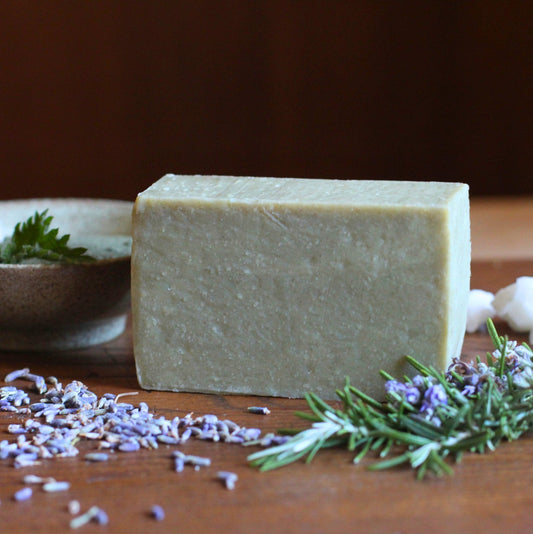
Our soap bars are made using the hot process method, which retains natural glycerin and produces a fully natural bar with a characterful finish.
The Original Herb Soap contains nettle powder — a mineral-rich botanical with prebiotic properties that help nourish the skin's natural microbiome alongside peppermint, rosemary, and lavender.
The Patchouli Soap Bar uses dandelion root powder, which is rich in inulin and polyphenols and has similar prebiotic action — alongside patchouli, ylang ylang, and a whisper of cinnamon.
Our Lavender Breeze Soap contains marshmallow root powder — a gentle, mucilage-rich botanical that has been used in skin care for centuries. Marshmallow root is naturally high in polysaccharides, which have prebiotic properties that help feed the beneficial bacteria on the skin's surface, supporting a balanced and resilient microbiome.
None of our soap bars contains synthetic fragrance, sulphates, or palm oil. All are formulated to cleanse without stripping — leaving skin clean, balanced, and not the slightest bit tight.
The honest answer
Can soap support a healthy skin microbiome? Well, Yes — but only if it's made with that in mind. Most aren't, but ours are.
The bar you use every day matters more than most people realise. It's worth knowing what's in it.