What is microbiome-friendly soap — and why does it matter for sensitive skin?
Share
If you've ever switched to a "gentle" soap and still found your skin feeling tight, dry, or irritated afterwards, you're not alone — and it might not be the soap's fault entirely. It might be what the soap is doing to your skin's microbiome.
It sounds technical. It isn't, really. Here's what you need to know.
What is the skin microbiome?
Your skin is home to billions of bacteria, fungi, and other microorganisms — collectively called the skin microbiome. Most of them are entirely harmless. Many of them are actively beneficial, helping to protect the skin barrier, regulate inflammation, and keep the less friendly microorganisms in check.
Think of it less like something that needs to be cleaned away and more like a garden that needs to be looked after.
What does soap do to it?
Most conventional soaps and body washes are alkaline — they have a high pH, which is effective at removing dirt and bacteria but also disrupts the skin's natural acid mantle. The acid mantle is a thin protective film on the skin's surface that keeps the microbiome balanced and the barrier intact. Disrupt it regularly and your skin starts to struggle — dryness, tightness, sensitivity, and reactivity are all common results.
Many commercial soaps also contain synthetic fragrances, sulphates, and preservatives that can further irritate the skin and alter the microbial balance. For skin that's already sensitive or compromised, that's a lot to deal with every day.
What makes a soap microbiome-friendly?
A microbiome-friendly soap is one that cleans effectively without stripping or disrupting the skin's natural balance. In practice that means:
- A pH that's closer to the skin's natural level (slightly acidic, around 4.5–5.5)
- No harsh detergents or sulphates
- No synthetic fragrance — natural essential oils at appropriate levels instead
- A short, considered ingredient list with nothing unnecessary
- Ingredients that support rather than strip the skin barrier
What about the method?
This is where it gets interesting — and where most people don't realise there's a difference.
Traditional soap making uses a cold-process method, where oils and lye are combined and left to cure over several weeks. It produces a good soap — but the heat generated during the chemical reaction can destroy delicate botanical ingredients before they ever reach your skin.
We use a hot-process method instead. The soap is cooked through to completion before the botanicals are added, which means the nettle powder, marshmallow root, dandelion root, chamomile powder and liquorice root go in after the saponification reaction is finished — intact, active, and doing the job they're supposed to do.
It's a slower, more involved process. But if you're going to the trouble of using botanicals with genuine skin-soothing properties, it seems worth making sure they actually survive into the finished bar.
What about the ingredients themselves?
Some ingredients have a particularly good reputation for being gentle on the skin microbiome. Marshmallow root is well regarded for its soothing and barrier-supporting properties. Liquorice root has a long history of use in calming reactive skin. Dandelion root is rich in antioxidants. And nettle — which we use in our Original Herb Soap — has a long history of use in skin-soothing preparations, with emerging interest in its prebiotic potential, though the research is still developing.
We're careful about the claims we make. What we can say with confidence is that our soaps are made with botanicals chosen specifically for their gentleness, added using a method that preserves their properties, with nothing that doesn't need to be there.
Why does this matter more as you get older?
As skin matures, the barrier naturally becomes thinner and the microbiome less resilient. Skin that tolerated a particular soap perfectly well in your 30s might start reacting to it in your 40s — not because the soap has changed, but because your skin has. Switching to something gentler, with fewer synthetic ingredients and more considered botanicals, can make a significant difference.
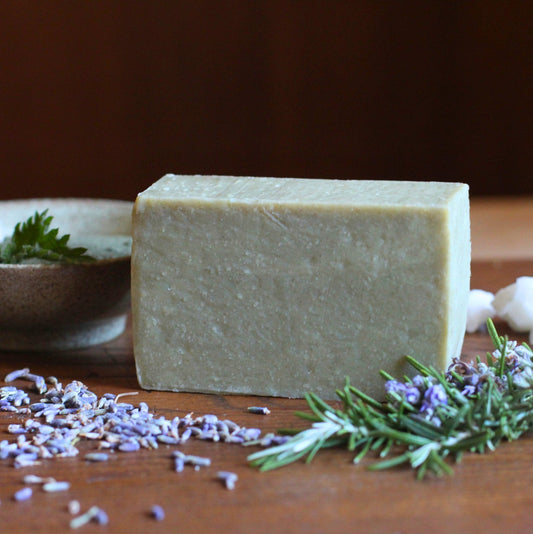
Our Original Herb Soap
Made in small batches here in the Usk Valley using the hot-process method, Lavender Breeze is built around lavender, lemongrass, and rosemary — with marshmallow root powder added after saponification to preserve its properties. Marshmallow root is a natural prebiotic ingredient, known to support the beneficial bacteria your skin relies on.
No synthetic fragrance, no sulphates, nothing unnecessary. It retains its natural glycerin for a smooth, creamy lather that leaves skin clean without feeling tight.
It's designed to clean without disrupting. Which, if your skin has been struggling, might be exactly what it needs.
Small-batch. Made in Wales. Nothing unnecessary.