How to Use Pot Pourri Around Your Home
Pot Pourri has traditionally been one of the simplest ways of bringing fragrance from the garden into the house.
A bowl of dried roses and herbs on a table might seem rather old-fashioned beside all the candles, diffusers and plug-ins we have now, but perhaps that's part of its appeal. There are no switches to turn on and nothing needs to be lit. You simply find a bowl you like, add the botanicals and leave them to gently fragrance the room.
And pot pourri doesn't have to live permanently in the middle of the sitting-room coffee table, either. There are plenty of places around the house where a small bowl of botanicals works beautifully.

In the hallway
The hallway is one of my favourite places for pot pourri.
It's the first part of the house you come back to and the first place visitors encounter, so a bowl on a console table, old chest or shelf gives a gentle hint of fragrance as you walk through the door.
You don't necessarily need a huge bowl. A fairly shallow dish allows the flowers and herbs to spread out and makes even a modest amount of pot pourri look abundant.
It's also a lovely place to change your fragrance with the seasons — fresher herbs and florals through spring and summer, moving towards woods, hedgerows and warmer fragrances as autumn arrives.
On a sitting-room table
This is probably the traditional home for pot pourri, and for good reason.
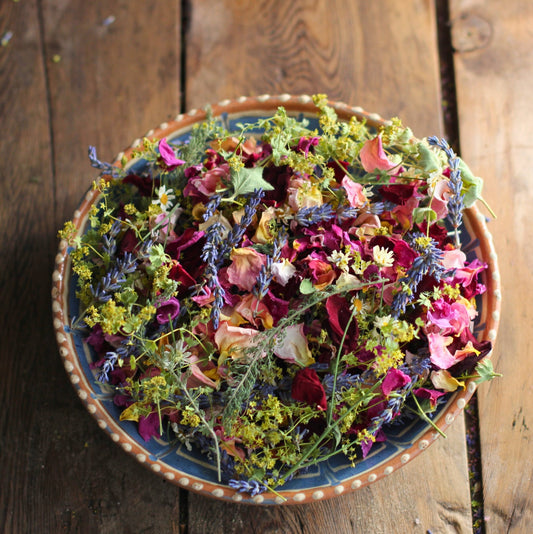
Natural botanical pot pourri is as much decoration as home fragrance. Rose petals, dried herbs, flowers, leaves and seed heads give a bowl colour and texture, so it can sit quite happily alongside books, a lamp or a few favourite things without looking like a conventional fragrance product.
A coffee table works well, but so does a side table or shelf.
If you have a large room, it's often better to use two smaller bowls in different areas rather than expecting one enormous bowl to fragrance the entire space.
Beside the bed
For a bedroom, I'd choose a smaller bowl and a gentler fragrance.
Lavender, soft florals and woody botanical blends work particularly well here. You don't need the fragrance to fill the whole room; often it's nicest when you simply notice it as you walk past or settle into bed.
Keep the bowl away from an open window, though. Apart from the obvious risk of petals disappearing across the bedroom on a windy night, constant draughts will disperse the fragrance more quickly.
In a guest room
Pot pourri is particularly useful in rooms that aren't used every day.
A little bowl on a dressing table or bedside table adds colour and fragrance without needing any attention between visits. Before guests arrive, gently turn the botanicals with your fingers and, if necessary, add a few drops of refresher oil.
It's a remarkably easy way of making a room that has been sitting quietly for a while feel welcoming again.
In the bathroom
Pot pourri can work in a bathroom, but choose its position carefully.
Dried botanicals naturally absorb moisture, so they won't appreciate sitting beside a steamy shower or bath. In a large, well-ventilated bathroom, a bowl positioned well away from splashes and humidity can be lovely.
For small or particularly steamy bathrooms, however, I'd use pot pourri elsewhere and save the botanicals from a rather soggy end.
On a mantelpiece or shelf
One advantage of pot pourri is that you don't need much surface space.
A narrow dish can sit on a mantelpiece, bookshelf or dresser, and it's a useful way of bringing a little natural colour into places where a vase of fresh flowers wouldn't be practical.
Just avoid placing dried botanicals directly above radiators, beside fires or close to candles and other naked flames.
Choosing a bowl
There really aren't many rules.
Old pottery bowls, shallow dishes, little wooden bowls and favourite pieces of vintage china can all work. Glass is lovely too, particularly if the blend contains interesting leaves, petals and seed heads that can be seen through the sides.
I generally prefer a wider, shallower bowl to a very deep one. It lets you see the individual botanicals and gives the fragrance more opportunity to disperse into the room.
You also don't need to arrange every petal perfectly. Tip the blend gently into the bowl, move a few of the larger flowers and seed heads until you're happy with it, and leave it alone.
Natural pot pourri looks best when it looks natural.
How much pot pourri do you need?
This depends on the room and how noticeable you'd like the fragrance to be.
A small bowl is quite enough for a bedside table or little hallway. For a larger sitting room, use a more generous bowl or divide your pot pourri between two dishes.
Natural pot pourri isn't intended to produce the very strong, constant fragrance of some synthetic room scents. It's much gentler than that. You'll tend to notice it as you move around the room or pass the bowl.
Refreshing the fragrance
Over time, the fragrance will naturally become softer. That doesn't mean the pot pourri has reached the end of its life.
Gently turning the botanicals is often enough to release some fragrance again. When it needs a little more help, add a few drops of a suitable refresher oil, mix very gently and allow it to settle.
It's better to start with a small amount and add more later than saturate the botanicals with oil.
With a little care, a good botanical blend can be enjoyed for many months, and the bowl itself will continue to change subtly as the flowers and leaves age.
Bringing a little of the garden indoors
Perhaps that's what I like most about pot pourri.
It doesn't just make a room smell pleasant. A bowl might contain roses picked at the height of summer, lavender gathered in July, herbs from the garden and seed heads collected as the fields begin to turn.
Months later, they're still there on the table.
Here on our family farm in the Upper Usk Valley, we grow, gather and dry many of the botanicals that go into our pot pourri throughout the seasons. Each blend is made by hand, so the flowers, leaves and herbs naturally vary a little from one harvest to the next.
If you'd like to learn more about how traditional botanical pot pourri works, continue with our Guide to Natural Pot Pourri.
Or you can explore our natural pot pourri collection, handmade with flowers and herbs grown and gathered here on the farm.