Lammas - As the wheat turns gold
Share
Have you noticed the subtle change in the countryside over the last couple of weeks?
Here in the upper Usk Valley, the fields are beginning to turn from green to gold. The wheat is almost ready for harvest, blackberries are starting to ripen along the hedgerows, and many of the herbs growing around the farm are reaching their peak.
The days are still long, the swallows are still skimming low over the fields, and the bees are as busy as ever, but there's a quiet feeling that the year is beginning to shift. Summer hasn't finished, but you can sense the first gentle hints of autumn waiting just beyond the horizon.
The 1st of August marks Lammas, one of Britain's oldest seasonal festivals. Although it's a tradition that's largely faded from modern life, it feels particularly fitting here on the farm, where the changing seasons still shape so much of what we grow, gather and make.
What is Lammas?
The word Lammas comes from the Old English hlaf-mæsse, meaning Loaf Mass. Traditionally, the first loaf baked from the new wheat harvest was taken to church as a thanksgiving for the season's first grain.
Long before that, our Celtic ancestors celebrated Lughnasadh (pronounced Loo-na-sa), one of the four great seasonal festivals. It marked the beginning of the harvest—a time to gather what the land had provided, celebrate with family and neighbours, and prepare for the months ahead.
Whether you know it as Lammas or Lughnasadh, the heart of the celebration has always been the same: taking a moment to appreciate what the land has given us.
Whilst most of us aren't harvesting fields of wheat today, I think there's still something rather special about pausing to notice the changing season.
Around the farm
This is one of my favourite times of year.
Much of the lavender has already been gathered and hung to dry, rosemary is full of fragrance, and the marjoram is alive with bees from morning until evening. As one harvest comes to an end, another quietly begins.
Walking around the farm at this time of year, there's a wonderful sense of abundance. Seed heads are forming, grasses are beginning to dry naturally in the fields, and everywhere you look there's something ready to gather for the months ahead.
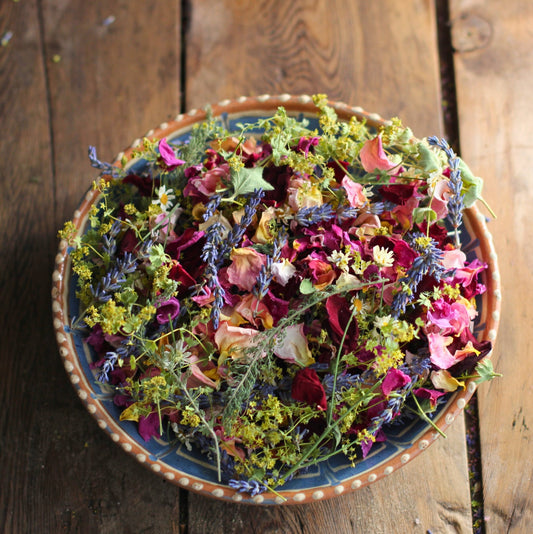
Many of the dried flowers and herbs that find their way into our botanical home fragrance collection are harvested around now, when they're at their most beautiful.
If you're growing herbs in your own garden, this is a wonderful time to gather a few for drying.
Some of my favourites include:
🌿 Lavender – ideal for drying while the flowers are still fresh and fragrant.
🌿 Rosemary – one of those herbs you'll always be grateful to have in the kitchen during winter.
🌿 Thyme – delicious fresh, but it also dries beautifully and keeps its wonderful flavour.
🌿 Lemon Balm – harvest now and you'll thank yourself when you're enjoying a calming cup of herbal tea on a chilly evening.
🌿 Calendula – cheerful orange petals that brighten everything from teas to homemade balms.
A little and often is usually best, leaving plenty behind for the bees and other wildlife to enjoy too.
A little reminder from nature
One of the things I love most about Lammas is the reminder that gardening isn't just about planting.
It's about noticing.
Noticing that the tiny seeds you sowed back in spring have become thriving plants.
Noticing the bees that have quietly pollinated them all summer long.
Noticing that every handful of herbs you've picked has taken weeks—sometimes months—to grow.
In our busy lives it's easy to rush from one season to the next, but Lammas encourages us to slow down for a moment and simply appreciate what's around us.
A simple way to mark the season
You don't need to follow ancient traditions to enjoy Lammas.
You could simply:
- Pick a handful of herbs to dry for winter.
- Bake a loaf of bread and share it with family.
- Take a walk through the countryside and admire the harvest fields.
- Spend ten quiet minutes in the garden with a cup of tea.
- Or simply stop for a moment and watch the bees going about their work.
Sometimes the simplest traditions are the ones that stay with us.
As the seasons turn
As I write this, the wheat in the fields is almost ready. Before long, the combine will once again get going, the hedgerows will begin to fill with berries, and another season will quietly give way to the next.
For now though, the herbs are still humming with bees, the evenings are still warm, and there's plenty to enjoy before summer slips away.
Here on the farm we're making the most of these last weeks of high summer—gathering herbs for drying, watching the fields change colour, and quietly appreciating another season in the upper Usk Valley.
Wherever you are, I hope you'll find a moment to pause, take in the season, and appreciate whatever the land is giving you this year.