From the Apothecary: Lavender
Share
Lavandula angustifolia — the most recognised herb in the apothecary, and one of the most popular natural skincare ingredients in the UK. There's a reason it keeps appearing on ingredient lists and in herb gardens across the country. It's genuinely useful, it grows well in Britain, and it smells amazing.
What It Is
True lavender is a hardy, evergreen shrub native to the Mediterranean but thoroughly at home in the UK. It flowers from June to August, producing the long purple spikes that have made it one of the most cultivated herbs in the world. The flowers and the essential oil distilled from them are both useful — in skincare, in the home, and in the garden.
Lavender for Skin
Lavender essential oil is one of the most versatile in natural skincare. It's used in formulations for dry, sensitive, and normal skin — it has a balancing quality that makes it broadly suitable rather than targeted at one skin type.
It's particularly well suited to dry or irritated skin, and to skin that needs something calming after sun, wind, or a long day outdoors. It's also one of the few essential oils considered gentle enough to use in low dilution — though a patch test is always sensible.
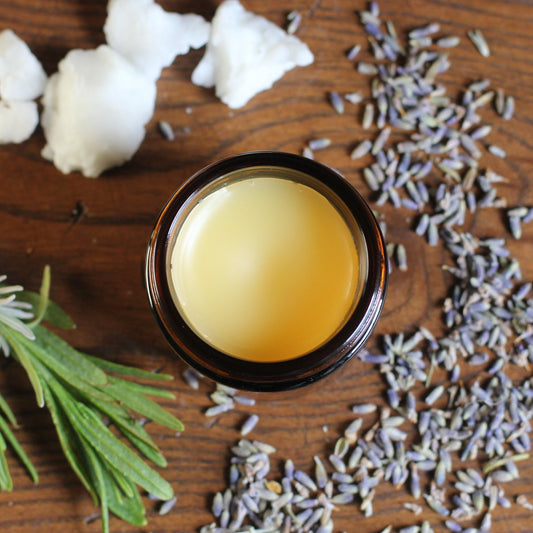
At Usk Valley Herbs, we use lavender essential oil — a consistent, high-quality steam-distilled lavender — in our The Lavender Balm, blended with beeswax, shea butter, and plant oils. It's one of our most popular products and one of the simplest formulas we make.
Simple Lavender Balm Recipe
This is the home version — a basic lavender balm using beeswax and a carrier oil. It's a good starting point if you want to understand how balms work before moving on to more complex formulas.
You'll need:
- 90ml carrier oil (jojoba, sweet almond, or sunflower all work well)
- 10g beeswax
- 15–20 drops lavender essential oil
Melt the beeswax gently into the carrier oil over a low heat — a heatproof bowl over a pan of barely simmering water works well. Remove from heat and allow to cool slightly (but not set). Add the lavender essential oil and stir to combine. Pour into a small tin or jar and leave to set without moving. Use within 6 months.
The essential oil goes in off the heat — adding it while the mixture is too hot will damage the fragrance and reduce its effectiveness.
If you'd rather skip the kitchen, our The Lavender Balm uses the same principle with a more complex base — shea butter, cocoa butter, and a blend of plant oils alongside the beeswax. Made in small batches by us here in the Usk Valley.
Lavender in the Bath
Dried lavender buds in a muslin bag make one of the simplest and most effective bath herbs. The warm water releases the essential oils slowly — more gently than adding essential oil directly to the bath, which can cause skin irritation. Soak for 20 minutes.
This is the botanical element in our Lavender Soak — dried lavender buds alongside a mineral salt base of Dead Sea Salt, Epsom Salt, and Magnesium Chloride.
Lavender Water
A simple lavender water — dried flowers steeped in boiling water and cooled — makes a gentle facial mist or pillow spray. Decant into a small spray bottle and use on clean skin or spritzed onto a pillow before sleep. Use within a week, kept in the fridge.
Around the Home
Dried lavender sachets in drawers and wardrobes are one of the oldest and most effective natural moth deterrents. The scent fades over time — refresh by squeezing the sachet to release more of the essential oil from the dried flowers. Replace annually.
In the Garden
Lavender is one of the best plants for pollinators in a British garden — bees in particular are drawn to it in large numbers. Plant in full sun in well-drained soil. It dislikes wet winters more than cold ones, so good drainage is essential. Prune lightly after flowering to keep the plant bushy and prevent it becoming woody. Don't cut back into old wood.
Fancy Growing Your Own?
Lavender is straightforward to grow in the UK given the right conditions — full sun, well-drained soil, and shelter from the worst of the winter wet. 'Hidcote' and 'Munstead' are the most reliable varieties for British gardens. Both are compact, hardy, and flower reliably from June.
Harvest flower spikes just as they begin to open for the strongest fragrance. Dry by hanging in small bundles in a warm, airy spot away from direct light. Dried lavender retains its fragrance well for 12–18 months.
Lavender has been in the apothecary longer than almost any other herb — and it's still there because it works. Not because it's fashionable, not because it photographs well (though it does), but because it's genuinely useful for skin, for sleep, for the home, and for the garden. Some things earn their place.